Why would two Geneva Lake area listings, priced within a few thousand dollars of each other, hand one buyer a private dock that passes with the deed and leave the other applying to a city committee for a slip that may or may not come through this season?
The answer has nothing to do with square footage or how recently the kitchen was updated. It comes down to a distinction that most buyers never think to ask about until they are already under contract: whether the parcel carries riparian frontage, where the right to place a pier is baked into ownership of the land, or whether water access on that address runs through a completely different system, one governed by an association's bylaws or a city lease application. On Geneva Lake, that distinction shapes what an address is actually worth to someone who wants to be on the water, not just near it.
Four Different Ways to Touch the Water
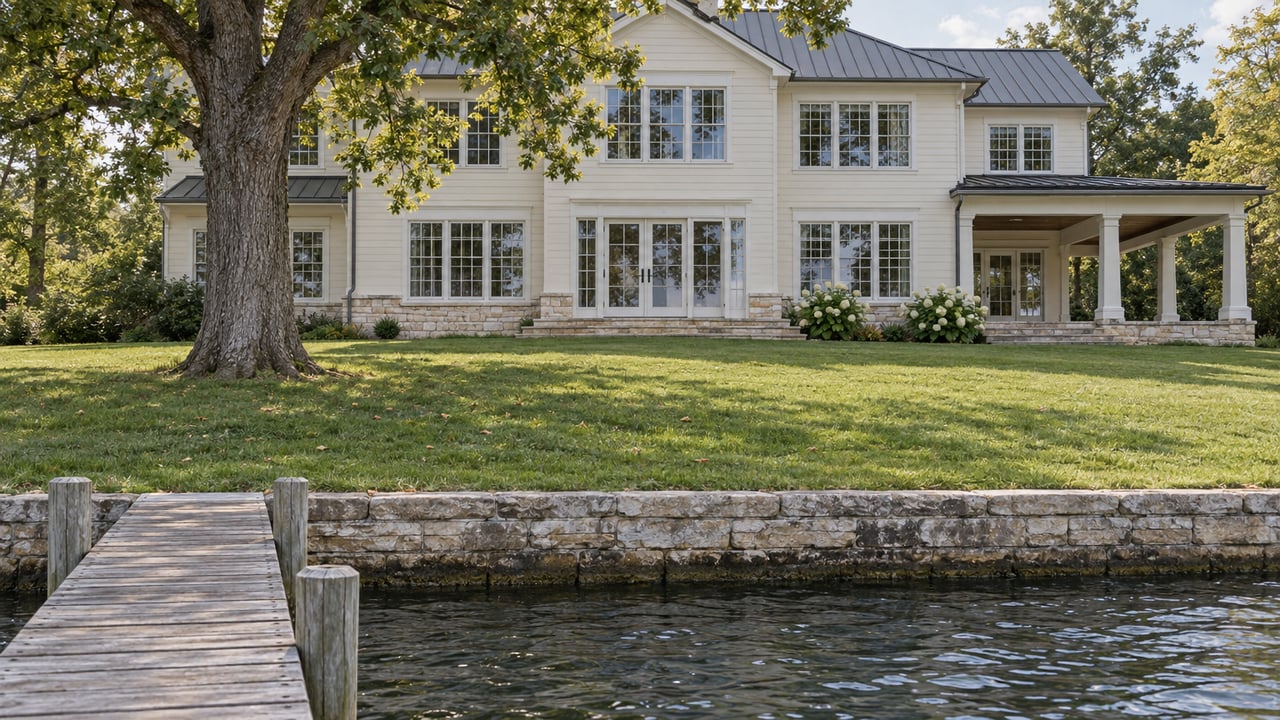
Wisconsin law ties the right to place a pier to riparian ownership, meaning the property boundary has to touch the lake at the ordinary high water mark. The state holds title to the lakebed below that mark under the public trust doctrine, so even a riparian owner doesn't own the water itself, only the reasonable use of it, subject to permits from the Wisconsin DNR and the local municipality.
That single legal principle produces four practical categories of access around Geneva Lake, and they are not interchangeable.
| Frontage type | What you actually get | What to verify before you buy |
|---|---|---|
| Direct riparian frontage | A private pier right attached to the deed, subject to DNR and municipal permits | A survey showing the ordinary high water mark and the pier's current footprint, plus prior permit history |
| Shared or association frontage | Access through an HOA-owned common shoreline, often with assigned slips | The association's governing documents, current waitlists, and per-slip fees |
| Deeded easement access | A recorded right to reach the water at one defined point | Whether the easement language actually allows a structure, since many are pedestrian only |
| View or near-water lot | Visual proximity to the lake with no legal claim to the shoreline | The nearest public beach or launch, and whether any separate deeded access exists |
A listing that says "lake rights" or "water access" could mean any of the middle two categories, and the difference between them shows up the first time you try to add a boat lift or transfer a slip to a buyer.
Inside City Limits, the Dock Is a Separate Application
The City of Lake Geneva runs its own docking system through the Piers, Harbors & Lakefront Committee, which recommends action to the Common Council on every commercial and private pier and buoy lease, including cost and length of term. The committee also oversees the Riviera piers along with buoys, dinghy pads, launching, and annual beach passes.
That matters because a slip in the city isn't something you inherit with the title. It's a lease you apply for, and the city's most recently adopted fee schedule prices that access by residency status, not by boat size or how long you've owned property nearby. So an in-town address near downtown Lake Geneva and a lakefront parcel a few miles away in Fontana or the Town of Linn can look like the same product on a listing sheet and function as two entirely different systems once you own them. One conveys a private pier with the deed. The other requires a separate application to a municipal committee, priced on a residency tier, with no guarantee of a slip the year you need one.
None of this argues against buying inside city limits. Walking distance to downtown, the Riviera, and the lakefront promenade is real value, and plenty of owners are content without private dockage. The point is narrower: if boat access is part of the plan, the comparison that matters isn't lakefront price against in-town price. It's whether the pier conveys with the deed or depends on a lease you'd have to apply for on your own.
The Pierhead Line Four Towns Share
Outside the city, Geneva Lake's shoreline runs through the Village of Fontana, the Town of Linn, and the Village of Williams Bay, and all three, along with the City of Lake Geneva, operate under a shared 100-foot pierhead line the four jurisdictions jointly established decades ago. That shared standard is part of why true riparian parcels around the lake behave more consistently with each other than any of them do with an in-city address that depends on the municipal lease system. The rule governing how far a pier can extend is the same lake-wide. What changes town to town is how frontage gets measured for zoning purposes, since Fontana's code measures lake frontage along the shore at the ordinary high water mark, and small differences in that measurement can affect how many slips or how much structure a parcel is allowed.
Buyers weighing a mooring buoy instead of a full pier have another layer to check. The Wisconsin DNR does not require a state permit for a buoy placed within 150 feet of shore, as long as it doesn't interfere with public or other riparian rights. Fontana still runs its own mooring buoy permit process and maintains a waitlist, which means a buoy that looks like the simple option on paper still runs through a local approval separate from the state rule.
What the Median Price Hides
Over the twelve months ending in July 2026, tracked closings across the City of Lake Geneva put the median sold price at $400,894, with the middle half of sales closing between $275,000 and $594,223, according to data updated in late August 2026. That figure blends everything that sold within city limits, from condos a few blocks from the water to homes that never touch the shoreline at all.
Active listings on true Geneva Lake waterfront parcels told a different story earlier in the year. As of April 2026, waterfront listings around the lake averaged roughly $628 per square foot, with an average asking price above $1.2 million. A citywide median in the low $400,000s and a waterfront average north of $1.2 million aren't describing different moments in the same market. They're describing different products that happen to share a ZIP code.
That gap is the practical reason a buyer needs to ask the frontage question before comparing any two Geneva Lake listings on price alone. A home priced near the citywide median could be two blocks from downtown with no lake claim at all, or it could be a shared-frontage property with an assigned slip through an association. Only one of those gets you a boat in the water without a separate negotiation.
Questions to Ask Before You Assume the Pier Comes With the House
A few checks turn this from an abstract distinction into something you can verify before closing.
- Ask for the deed and a current survey showing the lot line at the ordinary high water mark, along with the location of any existing pier.
- Request copies of pier permits, DNR authorizations, and municipal approvals rather than relying on what's visible from the water.
- If the property sits on shared or association frontage, review the governing documents for how slips are assigned, whether there's a current waitlist, and what the annual fee actually covers.
- If you're considering a home inside Lake Geneva city limits and want to be on the water, ask directly whether the address includes a deeded pier right or whether slip access would run through the city's lease system instead.
- Where the historic Geneva Lake Shore Path crosses a property's frontage, confirm the exact easement location with a survey, since it can affect privacy and how close you're able to build to the water.
None of these questions require a real estate license to ask. They just require knowing that "waterfront" on Geneva Lake is a category with real variation inside it, not a single guarantee.
A Few Straight Answers
Does every home that touches Geneva Lake come with a private pier? No. Direct riparian frontage typically allows a private pier subject to permits, but shared frontage, easement access, and view lots each carry different or no pier rights, even when the property is close to or borders the water.
If a listing says "lake rights," does that mean a boat slip is guaranteed? Not necessarily. "Lake rights" often points to shared or association frontage, where slip assignment depends on the HOA's bylaws and current waitlist rather than an automatic right tied to the deed.
Is a mooring buoy a simpler alternative to a pier? It can be, since the Wisconsin DNR doesn't require a state permit for a buoy within 150 feet of shore under most conditions. Local municipalities like Fontana still run their own buoy permit and waitlist process, so the state rule doesn't remove every layer of approval.
Understanding what a specific Geneva Lake address actually conveys, before you're comparing price per square foot across three listings that look identical on paper, is exactly the kind of question worth working through with someone local. If you're weighing a purchase anywhere along the lake and want a straight read on what the deed, the association documents, or the city's lease system would actually give you, Better Homes & Gardens Real Estate Dream Partners is glad to walk through it with you. Schedule a Consultation whenever you're ready to look at the paperwork behind a specific address rather than just the listing photos.